A roll-off dumpster arrives on a flatbed truck that tilts and rolls the container off onto the ground, which is why the delivery spot needs about 60 feet of straight clearance and roughly 12 feet of overhead height for…
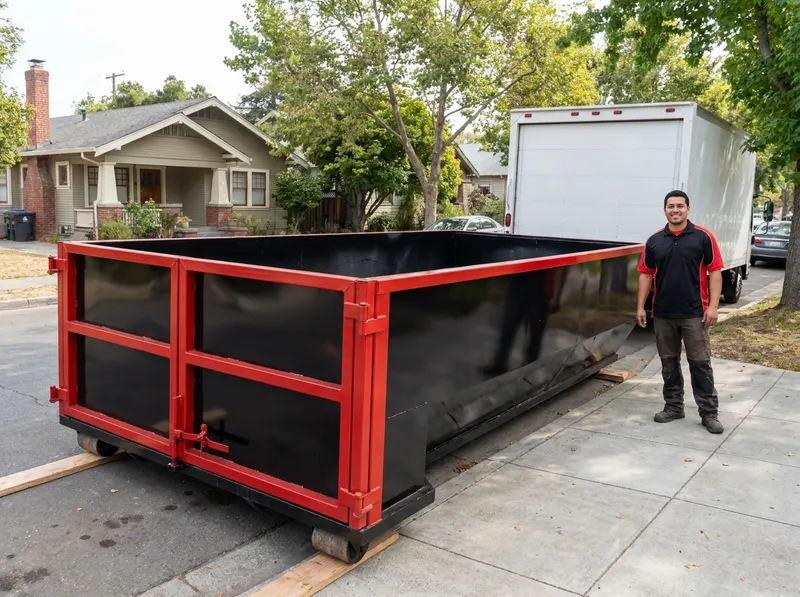
A roll-off dumpster arrives on a flatbed truck that tilts and rolls the container off onto the ground, which is why the delivery spot needs about 60 feet of straight clearance and roughly 12 feet of overhead height for the box to slide off cleanly. Oakland's narrow hill streets in Montclair and above Piedmont Avenue, plus steep driveways in the Dimond District and Maxwell Park, are exactly where a wrong-size drop damages property, so our team measures fit to the address rather than quoting blind. A 10-yard container measures roughly 12 feet long by 8 feet wide by 3.5 feet tall and slots into a single-car driveway; a 40-yard runs about 22 feet long and needs open street frontage or a large flat lot.
Decision-fit comes down to debris volume against the space you have. A 10-yard box, which holds about four pickup-truck loads, fits a single bathroom or kitchen gut and is the right choice for heavy concrete, brick or dirt because those loads hit weight limits long before they fill the space. A 20-yard box holds roughly eight pickup loads and suits a full-room remodel or a garage cleanout in West Oakland or the Laurel. A 30-yard or 40-yard box carries a whole-house cleanout or a roof tear-off, but on a tight Rockridge street the trade-off is real: the larger box may need a street placement and a City of Oakland encroachment permit, while a smaller box tucks onto the driveway with no permit at all. When debris is bulky but light, like construction framing or an estate clearance near Grand Lake, the larger box earns its size; when it is dense, the smaller box keeps the truck legal on the road.
Step 1, call (510) 201-6044 and describe the project and the drop location. Step 2, confirm the size and the flat price for your address. Step 3, clear the spot, move cars and low branches, since the flatbed needs the room to tilt. Step 4, the container is delivered and set square to the curb or driveway. Step 5, load it below the fill line, then call for pickup and hauling within the rental window. Household debris disposal in Alameda County is governed by state diversion rules under CalRecycle, and hazardous items are handled separately, so oil, batteries, tires, paint and electronics stay out of the box under the household hazardous waste program run by StopWaste and the federal RCRA hazardous waste rules; those go to a dedicated drop-off, not the roll-off. A roll-off rental is not junk removal, you load the container yourself, and our team handles delivery, hauling and disposal.
Where debris is C&D (construction and demolition), keeping loads clean helps recovery under EPA construction and demolition guidance, and jobsite loading follows OSHA jobsite safety practices for lifting and clear walkways. Common materials like scrap metal or cardboard are widely recyclable, and Earth911 recycling search lists local outlets if you separate them before the box arrives. For heavier fill such as asphalt and concrete, Caltrans recycled-material specs show how that debris is repurposed rather than landfilled. Container safety and lifting standards trace to ANSI standards and the roll-off industry practices reflected by the National Waste & Recycling Association. Street placement rules and encroachment permits come from the City of Oakland public works, and California's underlying waste framework sits with CalEPA CalRecycle.
Every job gets a firm, written price after an on-site visit.
Tell us about your roll-off dumpster delivery job in Oakland and we'll send a clear, written quote, usually the same day.
 Joshua Dumpster Rental